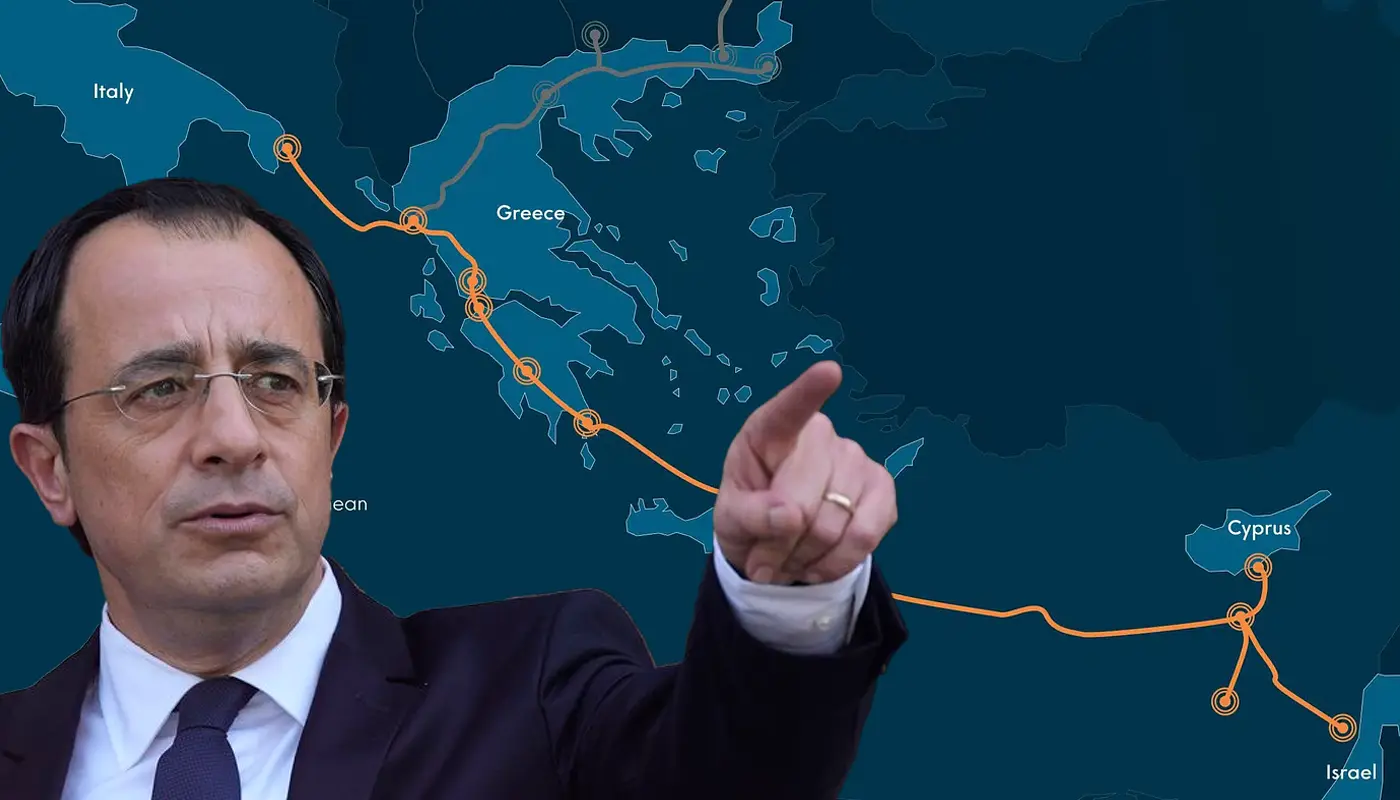
To avoid potential tensions in the Aegean, the Greek government rejected President of Cyprus Nikos Christodoulides’s proposal to delimit a joint exclusive economic zone (EEZ) between the two states. Mitsotakis rejects Christodoulides’s joint EEZ plan fearing Turkey.
How “wise” that decision proved to be is already apparent: with successive Navtex notices and threats that the research vessel Piri Reis will sail into the Aegean, Turkey has shown that it interprets Athens’s appeasing policy as weakness and is using it as a springboard for further claims.
Christodoulides’s proposal for an EEZ delimitation between Greece and Cyprus was intended to remove obstacles to completing the surveys required for the two countries’ planned electrical interconnector.
Such a delimitation would also have been a response to the Turkey–Libya memorandum and would have complemented diplomatic efforts to enforce the rules of the Law of the Sea, following the partial EEZ agreement between Greece and Egypt. But Greece declined to exercise rights flowing from the Greek–Egyptian accord when Turkey halted surveys for the cable off Kaso. So are we now to expect Greece to move forward with EEZ delimitation with Cyprus? According to diplomatic sources, the rejection of Christodoulides’s proposal was motivated by fear that it would provoke “a large and unpredictable escalation with Turkey.”
Yet the Navtex notices issued for the Piri Reis suggest that Athens’s conciliatory tactics are emboldening Ankara. In fact, a new Navtex is now in effect, by which the Turks are taking their threats directly into the heart of the Aegean against Athens. It should be noted that responsibility for search and rescue in this area — and for issuing Navtex notices — falls within Greece’s competence. Turkey, however, flagrantly ignores this. Perhaps Ankara has detected the anxieties that afflict the current Greek government and is therefore threatening a crisis or an escalation. It is also irrelevant that no EEZ has been formally declared in the area: the zone named in the Turkish Navtex lies within the Greek continental shelf and, according to the Law of the Sea, the continental shelf exists independently and does not require declaration in the same way as an EEZ.
In any case, avoiding a Greece–Cyprus EEZ delimitation harms both countries in multiple ways and allows Turkey to assert rights that do not belong to it, invoking arbitrary interpretations and illegal memoranda. Yet Athens could have deprived the Turkey–Libya memorandum of its foundation simply by extending its territorial waters to 12 nautical miles. Such a unilateral move — permitted under international law — would have made Turkey and Libya non-adjacent states, since Greek territorial waters would have interposed between their maritime zones. Here the question of casus belli arises, which is as unlawful as the Turkey–Libya memorandum, but the Greek government treats it seriously, as its timidity in taking measures to safeguard sovereign rights demonstrates.
Of course one would not expect Turkey to accept a Greek–Cypriot EEZ delimitation. But such a move would have forced Ankara to negotiate and to make substantial concessions with regard to the Turkey–Libya memorandum. Instead, and owing to Athens’s current submissiveness, Turkey is pressing further claims.