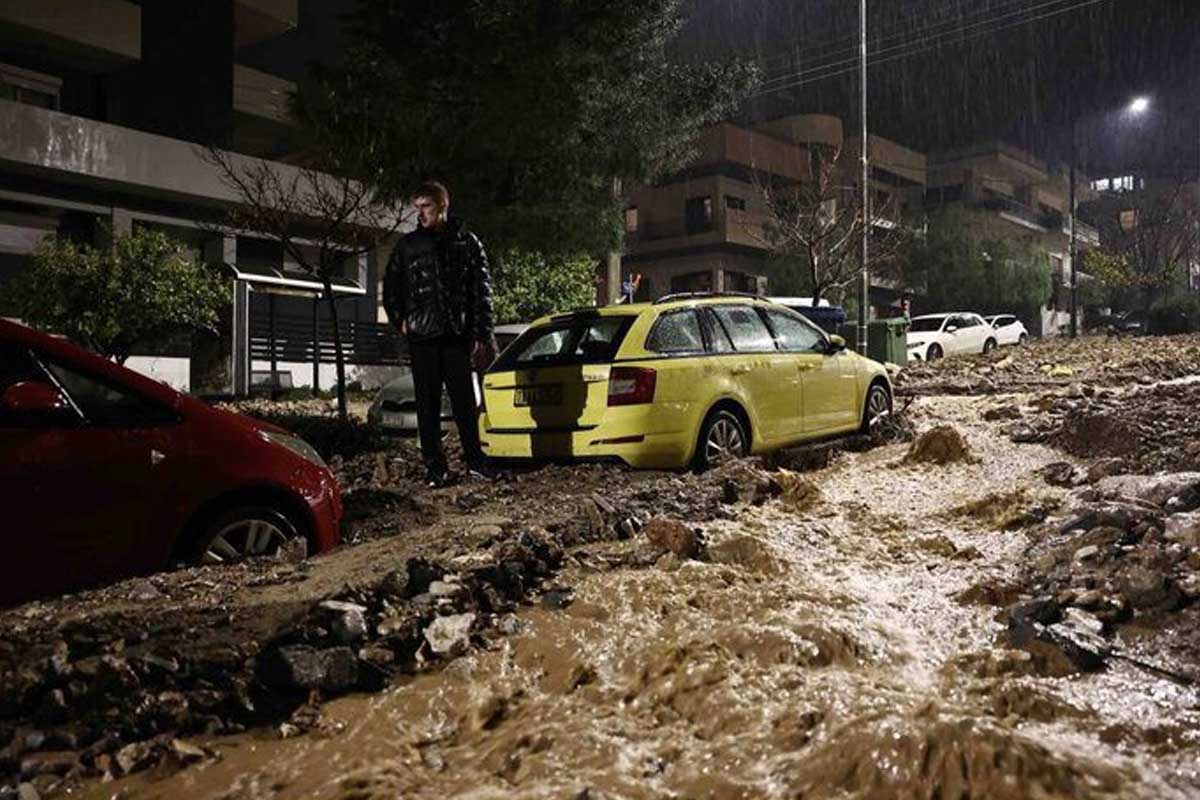
Attica was effectively “swamped” by extreme weather, with vast areas left underwater after rainfall levels exceeded all previous records. Residents were forced to dig their cars out of mud and debris carried by flash floods.
According to meteo.gr, based on forecast models and subsequent data recorded by the National Observatory of Athens’ network of automatic weather stations, the Rainfall Episode Hazard Index (RPI) at Category 5 was confirmed, as exceptionally high rainfall totals were recorded, primarily in Attica, the eastern Peloponnese and Evia.
The highest rainfall totals recorded by Wednesday evening were in Papagou (173.8 mm), Nomismatokopio (148.4 mm), Chalandri (148 mm) and Vyronas (145.2 mm).
A map released by meteo.gr shows total rainfall up to 23:40 on Wednesday, 21 January 2026, as recorded by 543 meteorological stations, highlighting the eight areas that received the most rain.
Thirty per cent of annual rainfall in just hours
Meteorologist Kostas Lagouvardos, Research Director at the National Observatory of Athens, outlined the sequence of events, noting that developments unfolded exactly as forecast:
“The forecasts predicting intense rainfall episodes—particularly in Attica—were confirmed. In Attica, we experienced two distinct phases of severe weather. The first occurred in the morning and late morning hours, with milder phenomena but still significant rainfall, which began to create the conditions for flooding, including water accumulation in the soil.”
This was followed by a second, far more destructive phase:
“The second phase brought intense thunderstorm activity, meaning very large volumes of rain in a very short period—essentially the recipe for flooding. This phase lasted two to three hours and produced exceptionally high rainfall totals.”
The recorded data were striking:
“We documented remarkable rainfall levels for Attica. In many stations, totals exceeded 100 millimetres. In Papagou we reached around 170 millimetres, while eastern Attica recorded between 120 and 130 millimetres in a single day—approximately 30 per cent of the area’s annual rainfall.”
The consequences of a burnt Mount Hymettus
The devastation in Ano Glyfada, where roads were buried under tonnes of debris and one fatality was reported, appears to be directly linked to the previously burnt slopes of Mount Hymettus.
Fire meteorologist Thodoris Giannaros, Senior Researcher at the National Observatory of Athens, directly connected the landslides to recent wildfires in the area:
“There is no doubt that yesterday’s landslide phenomena are linked to the fires that have affected Mount Hymettus in recent years. When vegetation is lost from a large mountain mass, the soil’s ability to remain stable is significantly reduced. As a result, during torrential rainfall events like yesterday’s, landslides become far more likely.”
He also explained why leaving burnt tree trunks in place can act as a flood-prevention measure—something often misunderstood:
“This is precisely why, even after major forest fires, it is sometimes recommended that burnt tree trunks remain where they are. Their root systems, which still exist, help to hold the soil together.”