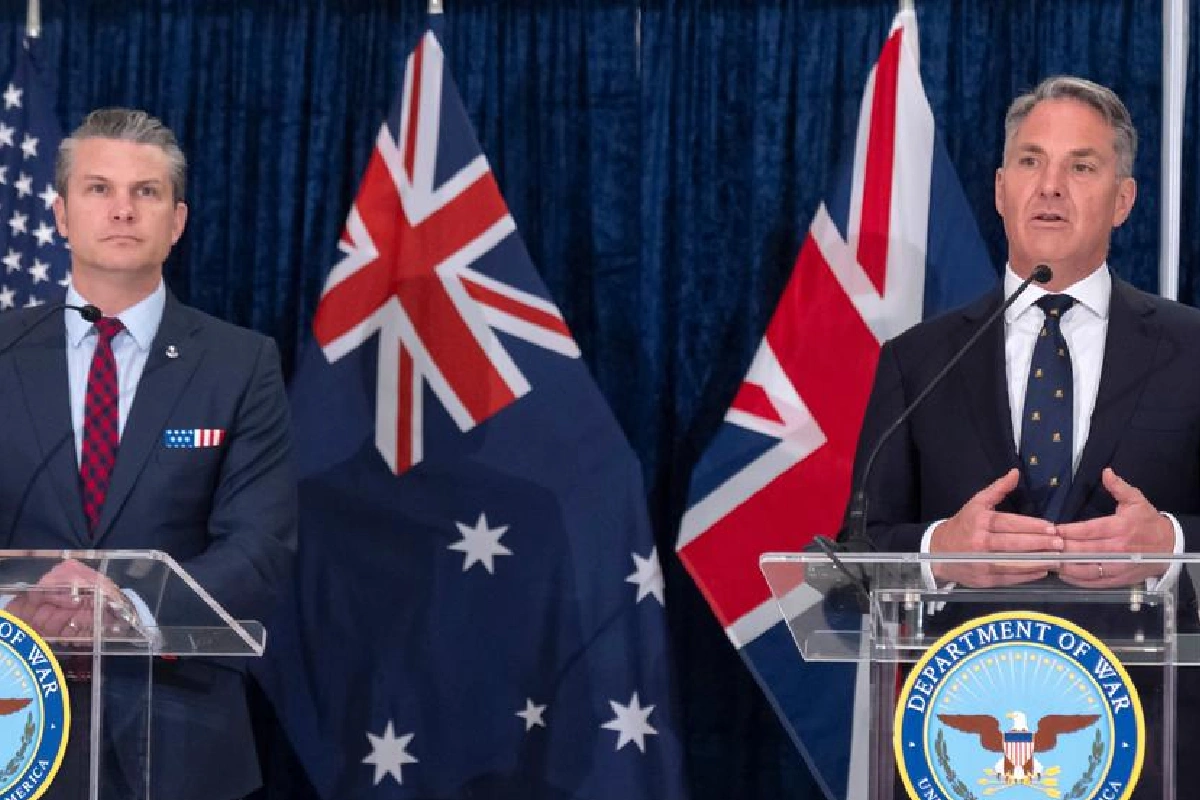
Australia has been thrust firmly into the spotlight of the AUKUS security pact, with both the United Kingdom and United States urging Canberra to accelerate its commitments and take on a greater share of the defence burden as the program shifts into its long-awaited delivery phase.
Following a high-level ministerial meeting at the Pentagon, Australia’s Deputy Prime Minister and Defence Minister Richard Marles stood alongside US Secretary of War Pete Hegseth and UK Defence Secretary John Healey, who both emphasised that Australia will play a critical operational, industrial and strategic role in the years ahead.
Mr Healey declared the UK was “all in” on AUKUS but stressed that the future of the trilateral submarine program depends on significant contributions from Australia as the host of key bases, the first Indo-Pacific operating location, and the hub for massive industrial expansion.
“Now that all three governments have completed their reviews, it is time to deliver,” he said. “And delivery means the most capable and most advanced attack submarines the world has ever seen.”
Mr Hegseth echoed the sentiment, praising Australia for “stepping up”, while making clear that Washington expects even more robust burden sharing under the doctrine of “peace through strength”.
“You’ll see in AUKUS a very practical application of hard power and real capabilities. Australia is stepping up, and we welcome that—but the work now intensifies,” he said.
Richard Marles acknowledged that Australia faces a steep challenge as it undertakes the largest defence project in national history. He confirmed that the AUKUS timeline remains “difficult but absolutely achievable”, citing the rapidly deteriorating strategic environment in the Indo-Pacific.
“We are facing the most challenging strategic circumstances since the Second World War,” he said. “That is why Australia must move quickly.”
Marles highlighted concrete progress underway. In recent weeks, the USS Vermont completed the most extensive maintenance ever conducted on a US nuclear-powered submarine outside American territory—work undertaken at HMAS Stirling in Western Australia. The event marked a significant milestone in Australia’s transition towards nuclear-powered submarine operations.
A central focus of the Pentagon talks was AUKUS Pillar II, which centres on advanced military capabilities including autonomous systems, long-range strike and integrated air defences. The ministers agreed the pillar needs sharper focus, after a major US think tank warned earlier this year that the scope was too broad to deliver results.
While the Pentagon has completed a five-month review of the pact, US officials have not released any recommendations, saying only that AUKUS remains “full steam ahead”.
Mr Healey said all three nations—each under newly elected governments—were aligned in their commitment.
“This is a major moment for AUKUS. The reviews are done. Now is the time to deliver,” he said.
For Australia, the next decade will require unprecedented defence investment, the expansion of naval infrastructure, the development of a skilled nuclear workforce, and seamless integration with two of the world’s leading military powers.
Marles said Australia is ready.
“This is a massive undertaking, and there is much more to do. But we are focused on delivering AUKUS, because Australia’s security depends on it.”