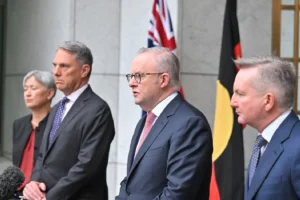
“Australian sporting icons demand a Royal Commission, the ball is in your court, PM” is the message now resonating across the country as pressure mounts on the Albanese Labor government to establish a Commonwealth Royal Commission into antisemitism, radicalisation and the events leading up to the Bondi massacre, with Australia’s most respected sporting figures now joined by Greek-Australian community leaders, organisations and faith bodies in calling for decisive national action.
In an unprecedented intervention, around 70 of Australia’s most respected sporting champions — including Dawn Fraser, Jess Fox, Pat Rafter, Ian Thorpe, Nova Peris and Grant Hackett — issued a joint statement demanding a Royal Commission, warning that antisemitism, intimidation and extremist violence now constitute a national crisis requiring a national response.
Their call has resonated strongly within the Greek community, which has publicly expressed solidarity with Australia’s Jewish community and backed the push for a federal inquiry, citing shared historical experience, democratic values and concern over rising extremism.
Greek community voices join the call
Greek-Australian organisations, community leaders and church figures have emphasised that antisemitism and political violence are not isolated issues, but threats to Australia’s social cohesion as a whole. Several community bodies have publicly endorsed the call for a Royal Commission, arguing that hate directed at one minority inevitably undermines the safety of all.
Community representatives have drawn parallels with the Greek community’s own historical experiences of persecution, displacement and political violence, stressing that silence in the face of extremism only enables its spread. Greek leaders have also highlighted the importance of confronting radicalisation early — particularly as Australia prepares to host the Brisbane 2032 Olympic Games, an event that will place the country under intense global scrutiny.
In public statements and community forums, Greek organisations have echoed the athletes’ warning that this is “bigger than politics”, and have urged the federal government to act with transparency, moral clarity and unity.
Broadening national pressure
Support for a Royal Commission now spans multiple sectors. More than 130 senior business leaders have backed a federal inquiry, arguing that only a Royal Commission has the authority, transparency and powers needed to examine systemic failures and restore public confidence.
Independent MPs — including several so-called “teal” members — have also formally called on Prime Minister Anthony Albanese to establish a Commonwealth Royal Commission, insisting that limited reviews lack the credibility required to address public concern.
Families of victims of the Bondi attack have likewise demanded national answers, stating that fragmented state-based processes and closed-door reviews cannot adequately address the broader rise in antisemitism and extremist violence.
Labor’s resistance
Despite the growing coalition of support — now encompassing sporting icons, business leaders, independent MPs, Jewish and Greek community organisations, and victims’ families — the Albanese government has continued to resist calls for a Royal Commission.
Instead, the Prime Minister has backed a time-limited federal review, alongside a NSW-led Royal Commission focused on policing and firearms regulation. Critics argue that this approach avoids scrutiny of broader social and ideological drivers, including antisemitism, and lacks the coercive powers, public hearings and independence of a Commonwealth Royal Commission.
Government ministers have defended their position on the grounds of speed and efficiency, but opponents say the approach risks appearing politically cautious at a moment demanding national leadership.
A question of national character
For supporters of a Royal Commission, the issue has moved beyond policy detail to one of national character and democratic values. The growing involvement of the Greek community — alongside Jewish organisations and other civic leaders — underscores the sense that Australia’s multicultural fabric is being tested.
As one Greek community representative put it privately: “When hatred is allowed to fester against one community, it never stops there.”
With pressure continuing to build from across Australian society, the question now confronting the Prime Minister is whether the government will maintain its resistance — or concede that only a Commonwealth Royal Commission can provide the transparency, accountability and unity the moment demands.