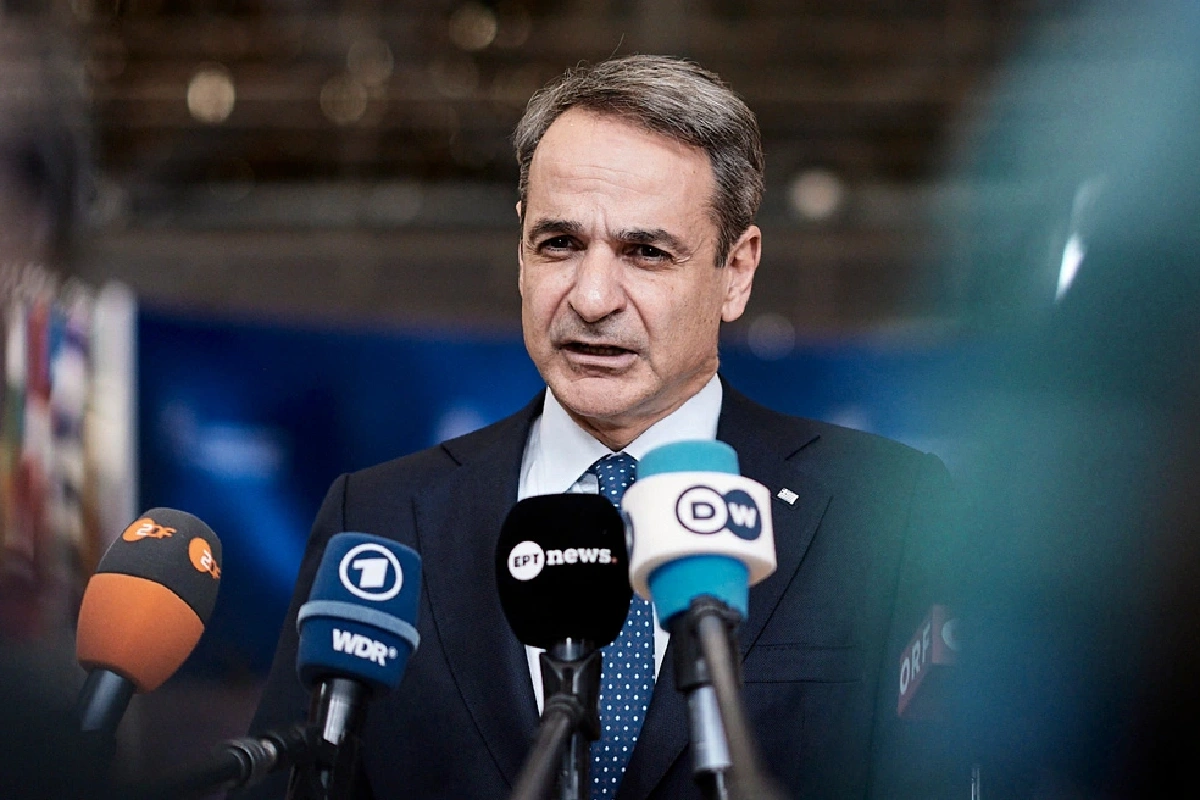
Greek Prime Minister Kyriakos Mitsotakis acknowledged that relations between Europe and the United States have gone through a turbulent period, while stressing that recent developments point to a modest improvement, following the conclusion of the European Council summit in Brussels.
Speaking at a press conference after the meeting, Mitsotakis said it was “no secret” that transatlantic relations over the past year had been tested by serious tensions. Nevertheless, he underlined that there is now a shared understanding on both sides of the Atlantic that these relations must be preserved at a functional and cooperative level.
“The objective is to pursue cooperation in good faith, without behaviours that could trigger developments that would later prove impossible to reverse,” the prime minister noted.
Improved climate after Trump clarifications
Mitsotakis said the atmosphere during the summit was noticeably better following recent clarifications by US President Donald Trump. In particular, he welcomed Trump’s statement that Washington does not intend to impose additional tariffs on countries that openly supported Greenland, nor to use military force to seize territory belonging to the Kingdom of Denmark.
“These clarifications have helped ease tensions and improve the overall climate,” Mitsotakis said, adding that such reassurances are critical for maintaining stability in EU–US relations.
Reservations over the Peace Council
Addressing questions about the proposed Peace Council initiative, Mitsotakis made clear that, in its current form, Greece — like most European countries — finds it difficult to participate. However, he recalled that Greece had played a key role in supporting UN Resolution 2803, which legitimised the US Peace Council strictly as a temporary administration mechanism for Gaza.
According to Mitsotakis, the original purpose of the initiative was to support the stabilisation of Gaza, facilitate a transitional administration and pave the way for reconstruction, forming the first substantive step toward resolving the Palestinian issue.
European presence in the Middle East
The Greek prime minister stressed that Greece has a direct interest in developments in the Middle East and supports a stronger European presence in the region. He noted that EU foreign policy chief Kaja Kallas, along with several member states, has expressed interest in exploring European-led initiatives, even if full participation in the Peace Council remains legally complex.
“We want Greece to be present. We want Europe to be present,” Mitsotakis said.
The Arctic as a global security priority
Although geographically distant from Greece, the Arctic was described by Mitsotakis as a critical priority for NATO and for the security of both Europe and the United States. He argued that close cooperation with Washington is essential to prevent an expansion of Russian or Chinese influence in the region.
Clear red lines on Greenland
On Greenland, Mitsotakis was unequivocal. “The red lines are absolutely clear,” he said, stressing that there can be no questioning of Greenland’s territorial integrity or sovereignty.
He emphasised that only Greenland itself and the Kingdom of Denmark have the right to decide the future of the territory, while acknowledging that US security concerns in the Arctic are legitimate and can be addressed through NATO cooperation and the 1951 US–Denmark defence agreement.
Strategic autonomy and European power
Concluding his remarks, Mitsotakis underlined the need for Europe to invest decisively in its strategic autonomy and competitiveness. He reminded journalists that Greece has consistently been among the strongest supporters of this approach since the Versailles Declaration.
“Europe must move from the strength of its values to the value of its strength,” he said, adding that this shift concerns both Greece and the European Union as a whole.