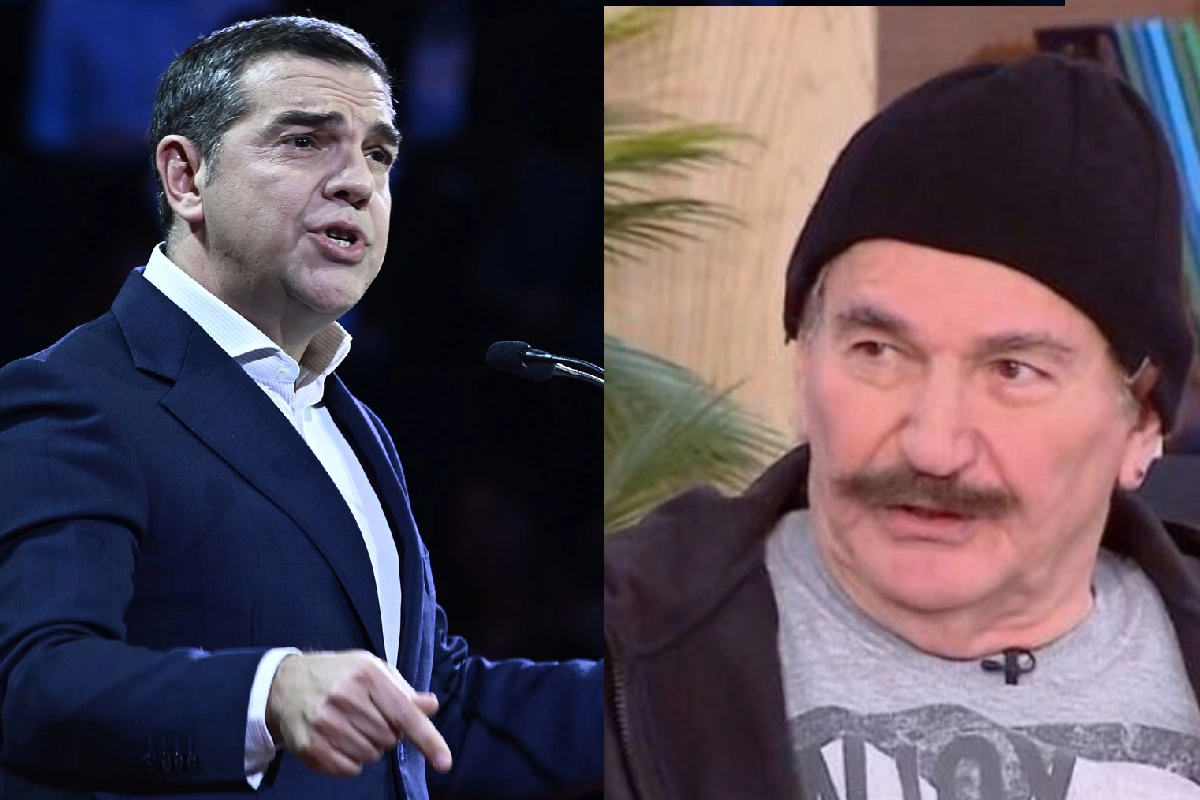
Greek actor and former MP Pavlos Kontogiannidis has issued an unusually harsh public critique of former prime minister Alexis Tsipras, accusing him of hypocrisy, political opportunism and an attempt to launch a new political party “without shame.”
His comments were delivered through a video posted on TikTok, where he criticised both Tsipras’ recent public statements and the political establishment more broadly.
The dispute erupted after the presentation of Tsipras’ new book Ithaca, an event that many observers interpreted as a soft launch of a new political formation. Kontogiannidis argued that the event resembled a campaign rally rather than a literary presentation, noting that Tsipras appeared alone on stage without a panel or other speakers — something he described as politically inappropriate and revealing of an overly personalised approach to politics.
Kontogiannidis, who was elected to parliament in 2012 with the Independent Greeks (ANEL) and in 2018 founded the “Movement of the Poor of Greece,” accused Tsipras of long-standing political contradictions. He criticised the former prime minister’s recent pledge that a future government would heavily tax the wealthy and channel the revenue to lower-income Greeks, dismissing the proposal as “populist nonsense.”
He pointed in particular to legislation introduced during Tsipras’ own premiership, which allowed high-income individuals to contribute a voluntary 2% tax on their profits — a measure he claimed effectively shielded wealthy elites, including shipowners, “some of whom now sponsor his new political project.”
The actor also revived several slogans and political positions associated with Tsipras during the 2015 crisis years, such as the “Go home, Mrs Merkel” rhetoric and claims that Greece would “play the drum and make the markets dance.” These earlier stances, he said, were incompatible with Tsipras’ current attempt to present himself as the leader of a grassroots political movement.
Kontogiannidis’ critique expanded beyond the former prime minister to include New Democracy and the broader political system, which he argued continues to operate through entrenched “mechanisms” that exploit ordinary citizens. He expressed deep frustration that, in his view, successive governments—regardless of ideology—have failed to break patterns of political elitism and self-interest.
Concluding his statement, Kontogiannidis described Tsipras as “self-absorbed, narcissistic and overconfident,” asserting that the new political initiative the former prime minister appears to be preparing is nothing more than another attempt to manipulate public sentiment. His intervention is expected to add fuel to the already heated political climate surrounding Tsipras’ next moves and the shifting landscape of the Greek centre-left.