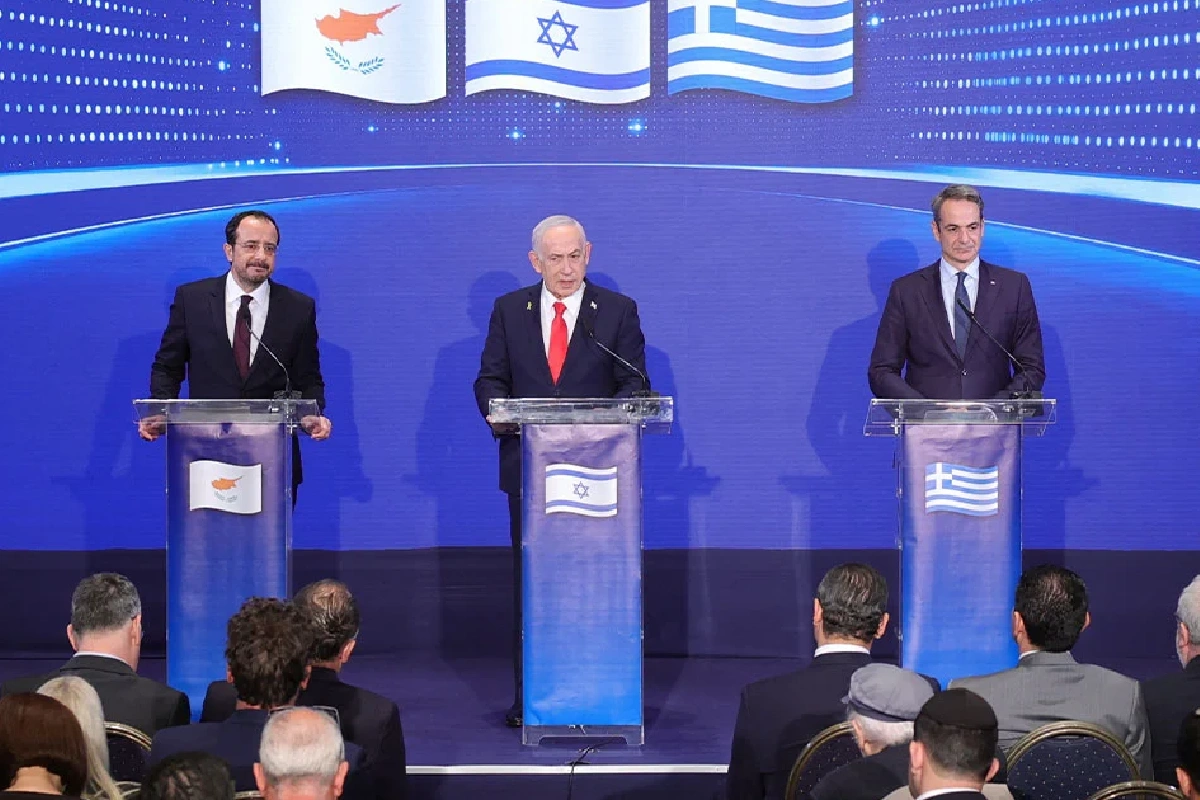
A strong geopolitical message was sent from Jerusalem on Monday following the completion of the 10th Trilateral Summit between Greece, Cyprus, and Israel, as Prime Minister Benjamin Netanyahu issued a pointed warning to those “who believe they can revive empires,” in an unmistakable reference to Turkey.
Speaking alongside Greek Prime Minister Kyriakos Mitsotakis and Cypriot President Nikos Christodoulides, Netanyahu declared that such ambitions “will not happen,” stressing that the three countries are democratic states in the Eastern Mediterranean committed to freedom, security, and regional stability. “Do not even think of it,” he said, underlining the trio’s determination to defend themselves against destabilising forces.
Prime Minister Mitsotakis emphasised that the Greece–Cyprus–Israel partnership carries strategic weight well beyond the three countries, reinforcing security and stability across the Eastern Mediterranean at a time of heightened geopolitical uncertainty. He acknowledged that the region has entered a new era, marked by both increased risks and significant opportunities.
Energy and connectivity featured prominently in the leaders’ discussions. Mitsotakis highlighted that Greece, like Israel, is poised to become a liquefied natural gas (LNG) exporter and underlined the importance of the vertical LNG corridor extending toward Ukraine. He also reaffirmed the significance of the 3+1 cooperation framework with the United States and stressed the need to transform ambitious concepts—such as the India–Middle East–Europe Economic Corridor (IMEC)—into tangible, deliverable infrastructure projects linking Asia, Cyprus, Greece, and continental Europe.
The Greek Prime Minister also expressed solidarity with the victims of the recent antisemitic terrorist attack in Sydney and condemned antisemitism in all its forms, stressing that religious hatred has no place in democratic societies.
On regional security, Mitsotakis reiterated Greece’s readiness to contribute to post-conflict stabilisation efforts, voicing strong support for Lebanon’s sovereignty and territorial integrity, as well as assistance to its armed forces. Referring to Syria, he underlined the importance of safeguarding peace while ensuring the protection of religious minorities, particularly Orthodox Christians in the Middle East.
Maritime security was another key focus, with Mitsotakis announcing forthcoming joint coast guard exercises between Greece, Cyprus, and Israel, reflecting their shared commitment to protecting sea lanes and critical infrastructure.
President Christodoulides echoed the strategic importance of the trilateral framework, particularly in energy, defence, and security cooperation. He reiterated Cyprus’s support for the US-backed humanitarian and security initiatives related to Gaza and highlighted the role of Greece, Cyprus, and Israel as a gateway connecting Europe with Asia through IMEC.
Netanyahu described the summit as the most substantive trilateral meeting to date, stressing that cooperation is no longer optional but essential in a region plagued by instability, terrorism, and conflict. He reaffirmed Israel’s commitment to advancing IMEC, expanding cooperation with India, and developing major energy and connectivity projects involving Cyprus and Greece.
The joint declaration reaffirmed the leaders’ commitment to annual summits, deeper cooperation in defence, counterterrorism, cyber and maritime security, climate action, energy, innovation, and artificial intelligence. It also underscored support for humanitarian corridors to Gaza, the fight against global antisemitism, and a just and lasting solution to the Cyprus problem based on international law and UN resolutions.