A meeting aimed at stability
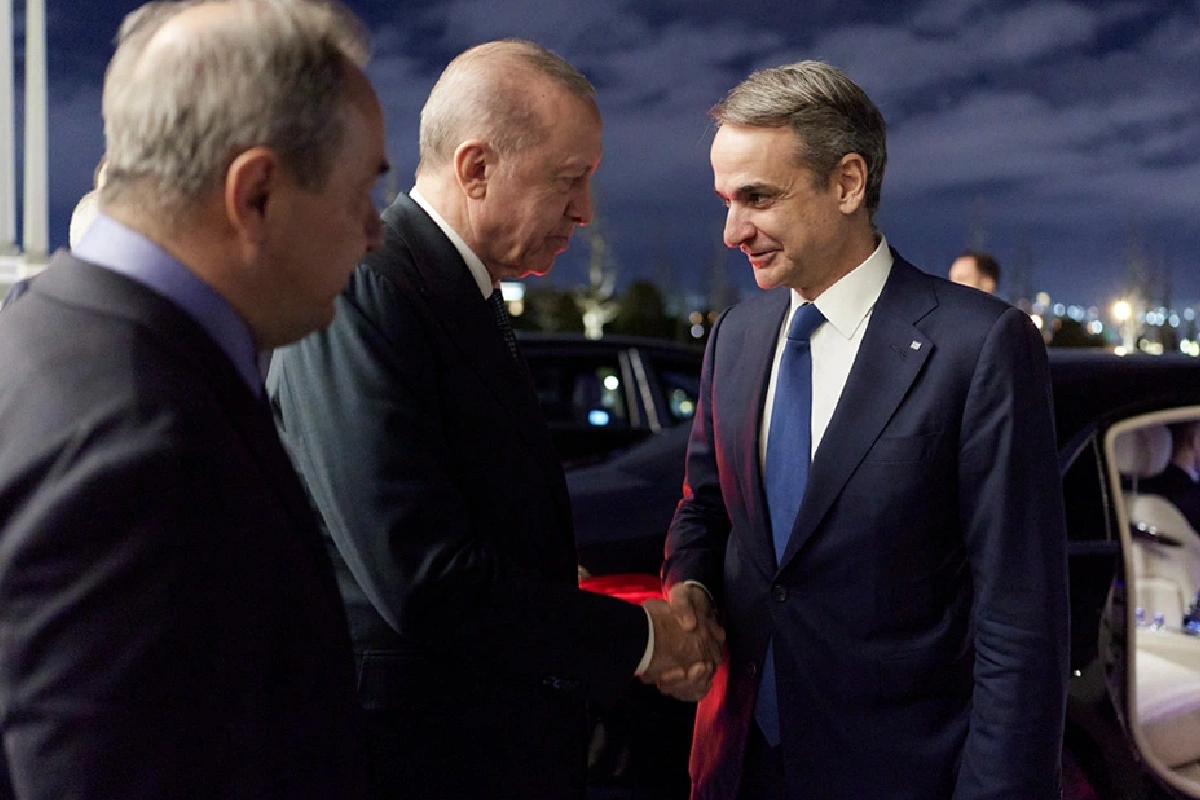
The meeting between Greek Prime Minister Kyriakos Mitsotakis and Turkish President Recep Tayyip Erdoğan in Ankara, held during the 6th Greece–Turkey High-Level Cooperation Council, confirmed that the current phase of bilateral relations remains defined by restraint, dialogue, and what both sides describe as “calm waters” in the Aegean.
Despite long-standing disputes, the two leaders chose low tones and emphasized the need to preserve open channels of communication. The one-and-a-half-hour tête-à-tête, followed by joint statements and an official dinner, took place in a notably positive—at times warm—atmosphere, according to diplomatic sources.
Dialogue without illusions
Both leaders acknowledged that serious disagreements remain, but stressed that disputes should be managed with composure and in accordance with international law. Prime Minister Mitsotakis reiterated Greece’s long-standing position that the only issue that can be referred to an international court is the delimitation of maritime zones—continental shelf and exclusive economic zone—in the Aegean and Eastern Mediterranean.
At the same time, he made a direct appeal to President Erdoğan to lift Turkey’s casus belli, in force since 1995. “It is time for every formal and substantive threat between us to be lifted. If not now, when?” Mitsotakis said, underlining that even when disagreements persist, crisis avoidance must remain the overriding priority.
Erdoğan: differences are not insoluble
President Erdoğan described Mitsotakis as a “valuable friend” and expressed confidence that bilateral problems are not insoluble if addressed on the basis of international law. He argued that since 2023 there has been tangible progress and suggested that further steps could be taken to address interconnected disputes in the Aegean.
While reiterating Turkey’s positions on the Aegean and Eastern Mediterranean, Erdoğan emphasized cooperation, dialogue, and regional stability, particularly given the broader geopolitical turbulence affecting NATO allies.
Cyprus, minorities, and international issues
On the Cyprus issue, Mitsotakis reaffirmed Greece’s support for UN-led initiatives, describing them as a window of opportunity to restart meaningful negotiations from where they stalled in 2017, strictly within the framework of UN Security Council resolutions.
On minority issues, the Greek Prime Minister was explicit: the status of minorities is clearly defined by the Treaty of Lausanne, which recognizes a religious minority in Thrace, rejecting any alternative interpretation. He stressed that Muslim Greek citizens live in harmony with Christian citizens under conditions of equality before the law.
Both leaders also exchanged views on Ukraine, Gaza, the Middle East, and Syria, agreeing on the need for diplomacy, de-escalation, and respect for international law.
Bilateral agreements and economic goals
Following the leaders’ talks, Greece and Turkey signed six bilateral agreements and a joint declaration, covering areas such as investment promotion, disaster preparedness, cultural cooperation, technology, and a proposed ferry connection between Thessaloniki and Smyrna.
A key economic target outlined in the joint declaration is the increase of bilateral trade to $10 billion by the end of the decade, reflecting a shared belief that economic interdependence can reinforce political stability.
Opposition reactions in Greece
Greek opposition parties reacted cautiously or critically. PASOK warned that Turkey’s revisionist claims and the continued casus belli undermine prospects for substantive progress. SYRIZA accused the government of prioritizing optics over substance, while the Communist Party (KKE) argued that the focus on a “positive agenda” masks unresolved sovereignty challenges.
Cautious optimism, strategic patience
Despite persistent disagreements, the Ankara meeting reinforced a shared understanding that escalation benefits neither side. As Mitsotakis concluded, geography cannot be changed—but it can be transformed into an ally through dialogue, cooperation, and adherence to international law.