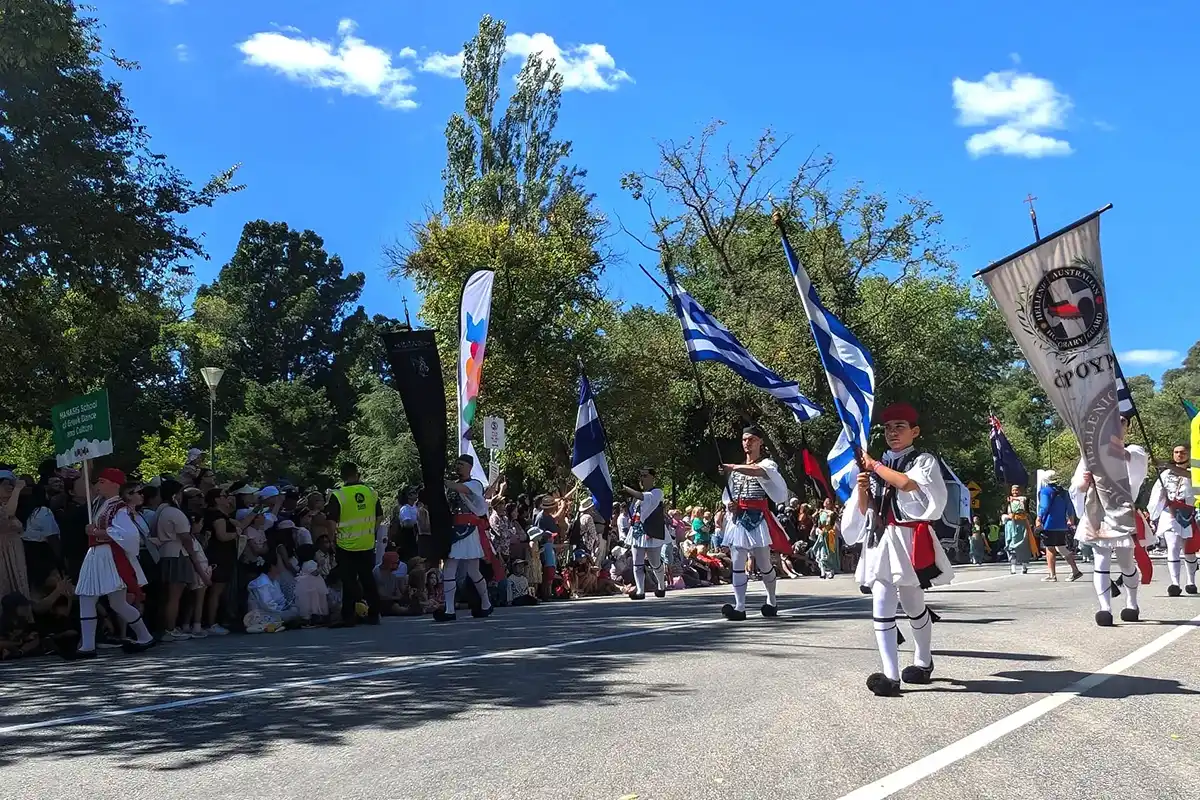
A dispute has emerged ahead of Melbourne’s Moomba Festival parade after organisers confirmed that the Vergina Sun flag will not be permitted during the event. Dispute erupts over Vergina Sun ban at Moomba Festival parade. The City of Melbourne has introduced guidelines stating that participants in the parade, scheduled for Monday 9 March in the city centre, may carry only official national flags or organisational banners. Cultural or regional flags will not be allowed, with organisers citing the “sensitive nature” of certain symbols in multicultural settings.
The decision has prompted strong reactions from organisations representing Australians of SKOPIA (North Macedonian) background, some of which have indicated they are considering legal action over the restriction.
Several groups had planned to march in the parade carrying a flag featuring the Vergina Sun, a symbol they refer to as the Kutlesh Star. Community representatives argue that the emblem reflects their cultural identity and insist its display in the parade would not be political.
However, the issue is tied to a longstanding historical and diplomatic dispute in the Balkans, where the symbol has been the subject of intense disagreement for decades.
The heritage of the Star of Vergina
The Star of Vergina, also known as the Vergina Sun, is an ancient symbol closely associated with the Greek kingdom of Macedonia. It gained worldwide recognition in 1977 when Greek archaeologist Manolis Andronikos discovered the emblem on a golden larnax in the royal tombs at Aigai (modern-day Vergina) in northern Greece.
The tomb is widely believed to belong to King Philip II, the father of Alexander the Great, linking the symbol directly to the royal Argead dynasty and the ancient Greek kingdom of Macedonia. Since that discovery, the sixteen-ray star has become internationally recognised as an emblem of ancient Macedonian Hellenism and is today a protected national symbol of Greece.
A symbol at the centre of modern controversy
The Vergina Sun became the focus of international controversy in the early 1990s after the breakup of Yugoslavia, when the newly independent former Yugoslavia Republic of Macedonia (FYROM) adopted the symbol as its national flag in 1992. Greece strongly opposed the move, arguing that the emblem represented an integral part of Greek historical heritage.
Following diplomatic pressure and negotiations mediated by the United Nations, the symbol was removed from the country’s flag in 1995. The dispute later formed part of the wider disagreement over the country’s name, which was eventually resolved through the Prespa Agreement in 2018, when the state officially adopted the name North Macedonia.
Despite this agreement, the symbol continues to be used by some diaspora organisations, often reigniting sensitivities around cultural heritage and historical identity.
Cultural appropriation
Many Greek organisations argue that the use of the Vergina Sun by groups not connected to Greek Macedonia amounts to appropriation of another nation’s historical heritage.
They maintain that the symbol is inseparable from the archaeological discoveries at Aigai and the legacy of the ancient Macedonian kingdom, and therefore its use outside that historical context misrepresents the origins of the emblem.
Supporters of this view say that allowing the symbol to be used by unrelated groups effectively rewrites historical identity and undermines internationally recognised cultural heritage.
Legal concerns raised
Organisations representing the FYROM (North Macedonian) community in Australia argue that preventing the display of the flag could raise questions under Victoria’s Charter of Human Rights and Responsibilities, particularly regarding freedom of expression and cultural identity.
Community representatives say the symbol holds cultural significance for them and claim its use in community events should not automatically be interpreted as political.
City of Melbourne officials, however, have maintained that the parade policy applies equally to all participants.
In a statement, a council spokesperson said the rules were designed to ensure the Moomba parade remains inclusive and free from symbols that may create tension among different communities.
“Our approach is consistent for everyone participating in the parade. Only official national flags and organisational banners will be permitted,” the spokesperson said.
Reaction from the Greek community
The decision has been welcomed by organisations representing the Greek community.
In a statement, the association reiterated that the sixteen-ray star is internationally recognised as a symbol connected to the ancient Greek kingdom of Macedonia and the legacy of Philip II and Alexander the Great.
The organisation added that cultural diversity should be celebrated in ways that respect historical accuracy and mutual understanding between communities.