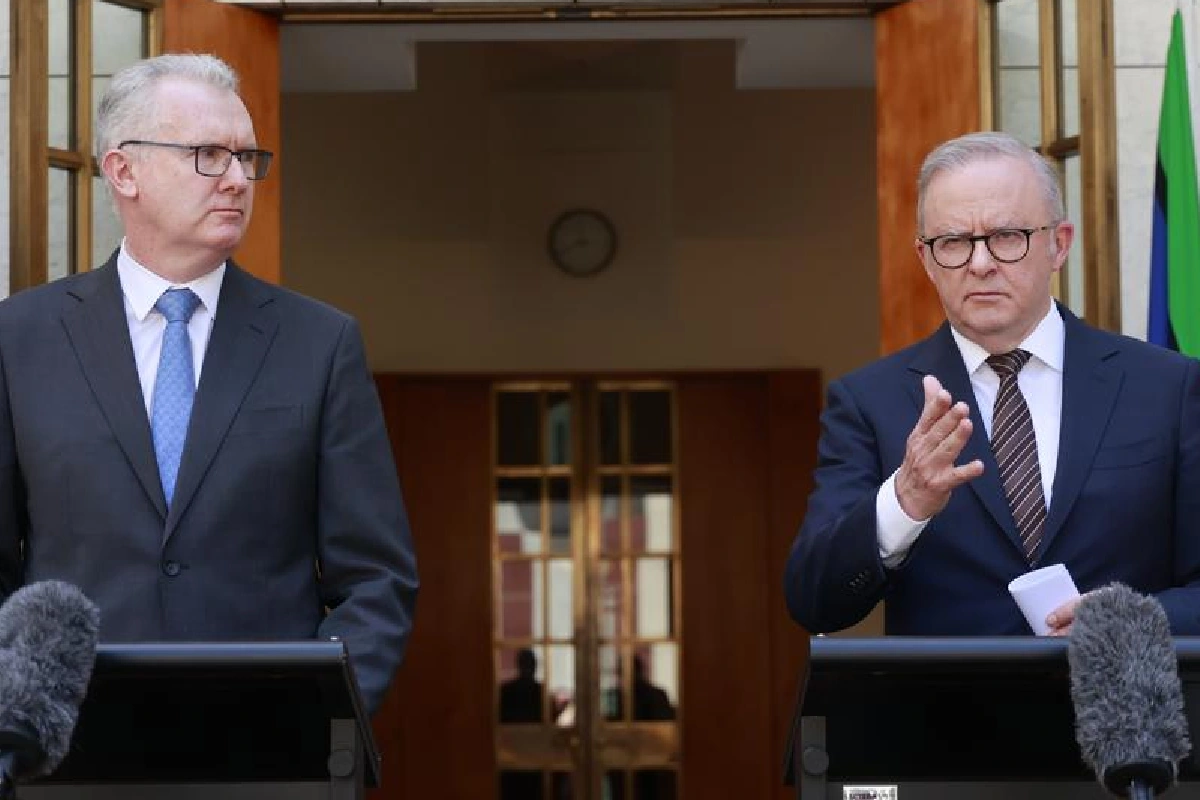
The federal government has conceded that proposed laws to ban extremist hate groups will not eliminate extremist ideology from Australia, with Home Affairs Minister Tony Burke acknowledging that most individuals holding such views are Australian citizens who cannot be deported.
The admission comes as the Albanese government moves to outlaw organisations such as Hizb ut-Tahrir and the neo-Nazi-linked National Socialist Network (NSN), amid heightened national concern over extremism following the Bondi terror attack, which left 15 people dead.
Speaking about the limitations of the proposed legislation, Burke said that while banning organisations would disrupt recruitment and public mobilisation, it would not eradicate hateful beliefs entirely.
“For most of these people, they’re Australian citizens,” Burke said. “That means deportation is not an option.”
The issue has been thrust into sharper focus following revelations that, on Christmas Eve, Burke cancelled the visa of Yan Zakharin, a Ukrainian national accused of neo-Nazi activity. Zakharin was among 15 NSN members who stormed the Camp Sovereignty protest site in Melbourne in August, an incident that led to charges including violent disorder, affray, and discharging a missile to cause injury.
Zakharin is currently being held in immigration detention in Melbourne. If convicted, he will be required to serve any custodial sentence before deportation. Violent disorder carries a maximum penalty of 10 years’ imprisonment, while affray can attract up to five years.
The case highlights the government’s ability to act decisively where extremists are visa holders — a power Burke says he has used repeatedly. In recent months, visas have also been cancelled for Matthew Gruter, a South African national who attended a neo-Nazi rally outside the NSW Parliament, and a British national charged with displaying Nazi symbols.
However, the government faces far greater constraints when dealing with Australian citizens involved in extremist movements.
Proposed federal laws would make membership of a banned hate group punishable by up to seven years in prison, while leaders, recruiters, funders and trainers could face penalties of up to 15 years. The legislation would also prohibit public gatherings and recruitment activities linked to extremist organisations.
Despite this, Burke acknowledged that extremist leaders may simply push their operations underground. He argued, however, that forcing such groups off public platforms would significantly weaken their ability to radicalise new members.
“Their preferred terrain is public events,” he said. “That’s how they recruit. Forcing them to the fringes matters.”
The legislation’s passage is not guaranteed. The government was recently forced to split its broader hate-speech bill after racial vilification provisions were rejected by both the Coalition and the Greens, amid concerns from religious and civil liberties groups over free speech.
While the Coalition has long supported banning extremist organisations, negotiations over the final shape of the laws remain ongoing.
Burke insisted the government’s position was uncompromising.
“Our government has zero tolerance for bigotry and hate,” he said. “If you don’t like Australia, you can leave.”
The debate underscores a central reality confronting Australian policymakers: extremism can be constrained, disrupted and punished — but not legislated out of existence.