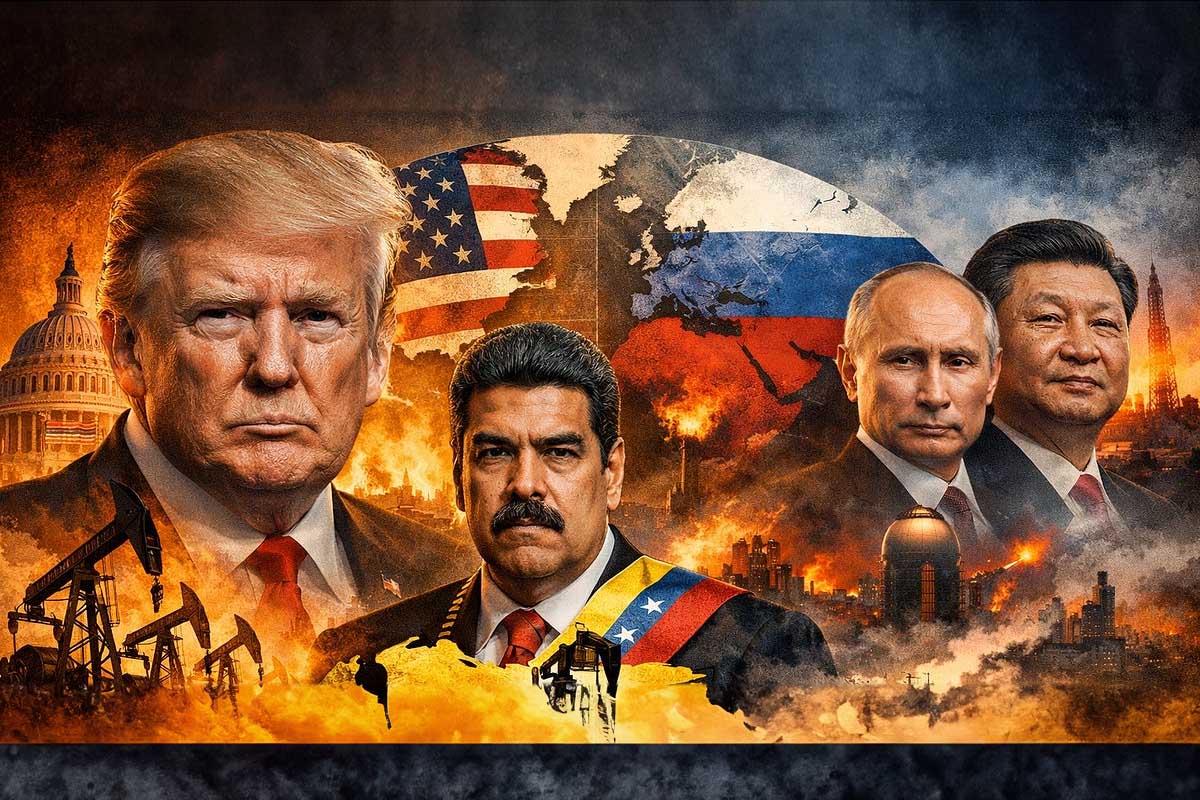
Venezuela was never about democracy — it is a resource war, not a morality tale but a balance-sheet conflict dressed up as benevolent intervention. The country sits atop roughly 303 billion barrels of oil, much of it heavy crude — precisely the type many refineries were engineered to process once shale optimism collided with physical limits. Texas and Louisiana host some of the world’s largest heavy-oil refining complexes for a reason: they need that feedstock, and Venezuela has it.
Sanctions didn’t reform Caracas; they degraded infrastructure, halted steam injection, and turned geology into bargaining power. The collapse in Venezuelan output wasn’t merely mismanagement—it was pressure converting time into scarcity.
Track the production curves and the façade disappears. Two decades ago, Venezuela outproduced the United States. By 2020, sanctions, capital blockades, and equipment decay had driven output below a million barrels a day, while U.S. production surged. At the same time, America’s reliance on heavy crude quietly swelled from marginal to essential. Canada stepped in and now supplies most of it—but that reliance is fragile. Pipelines, politics, and price cycles don’t answer to press briefings. The real prize is a second heavy-crude artery, and it runs through the Orinoco.
Oil is only the opening act
Venezuela also holds substantial natural gas reserves—largely undeveloped—alongside gold, silver, bauxite, iron ore, and a growing strategic position in regional lithium corridors. These aren’t just commodities; they are inputs of power. You can print currency, but you can’t print silver’s conductivity, copper’s density, rare-earth magnetism, or battery-grade lithium. The era when trust papered over shortages is ending. When trust fails, physics reasserts itself.
That’s why the rhetoric shifted. Not reconstruction—control. Not partnership—extraction. When leaders speak openly about “running” a country from afar while deploying corporations to “fix” infrastructure and “sell large volumes” abroad, they’re not unveiling a doctrine. They’re narrating asset seizure: rebrand a sovereign economy as a distressed portfolio, then appoint yourself receiver.
Here lies the strategic error history never overlook
You cannot govern a nation from a spreadsheet. You can’t administer millions of resentful citizens by sanctions or remote directives. Guaranteed throughput requires consent—or boots. And boots quickly turn balance sheets red. Occupation drains legitimacy, budgets, and lives. Proxy management invites sabotage. Every pipeline becomes leverage, every port a chokepoint, every election a great-power contest.
Worse still, the precedent radiates outward
If leader removal, maritime strangulation, and corporate carve-ups are normalized as “law,” then law ceases to constrain. The global majority reads the signal plainly: negotiation is decorative; deterrence is decisive. That doesn’t move the world toward compromise—it pushes it toward hard shields, including the kind that end debates permanently. When trust is burned, imperial wagers unravel.
Timing matters, too. As critical-mineral and maritime chokepoints tighten, export controls bite, and precious metals reclaim their role as stores of reality, the old petro-fiat illusion frays. You can’t sanction your way out of metallurgy. You can’t embargo your way into credibility. You can’t lecture supply chains into obedience when the inputs lie elsewhere—and your rivals hold them.
So the board expands. Heavy crude here. Gas there. Metals everywhere—few under overt U.S. control. Sea lanes, straits, and near-abroad naval chokepoints regain importance, not as abstractions but as lifelines. Every “quick win” becomes a future liability. Every forced deal teaches the same lesson to a watching world. This isn’t a smash-and-grab; it’s an attempt to re-anchor a weakening system to things it can’t fabricate—hard metals and hard assets. That’s exactly why it’s dangerous. Declare that might sets precedent, and you invite a world that prepares accordingly. In that world, restraint isn’t rewarded, trust isn’t extended, and peace isn’t assumed.
The reckoning won’t arrive as a headline. It will arrive as structural silence—when deals stall, buffers vanish, and real deterrence replaces empty dialogue. That’s the ledger no one wants to publish. It’s also the one the future always audits.